The Red Sea is not merely a destination; it is a global benchmark for marine biodiversity, clarity, and architectural coral formations. Yet, the typical experience offered by mass-tourism operations—crowded daily boats, rigid group schedules, and rushed site briefings—often dilutes the profound serenity that deep-water exploration is supposed to provide.
To truly experience the underwater majesty of Hurghada requires a shift in perspective. It requires moving away from the standard tourist tracks and embracing a tailored, private guiding model. By matching world-class aquatic environments like the Giftun Island Reefs with an elite standard of personalized dive logistics, you unlock the Red Sea exactly as it was meant to be seen: pristine, silent, and entirely on your own terms.
Giftun Island: The Refined Choice for Relaxed Guiding
While Hurghada features dozens of distinct dive areas, the marine protected zone surrounding the Giftun Islands (Greater Giftun and Lesser Giftun) remains an undisputed jewel of the northern Red Sea. Characterized by spectacular visibility that frequently exceeds $30\text{ meters}$, these sites offer a distinct blend of gentle topographical profiles and hyper-vibrant marine health.
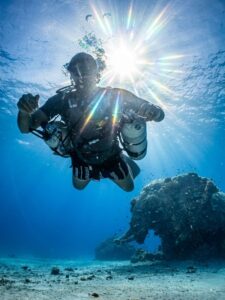
For photographers, videographers, or those looking to master their hydrodynamic trim in a tranquil environment, the Giftun reefs represent the ultimate underwater studio.
The Anatomy of Giftun’s Topography
Unlike the sheer drop-offs of the southern Red Sea, which demand strict depth awareness and high-level current management, the reefs around Giftun offer beautifully stepped structures.
- Shallow plateaus ranging from $5\text{ to }12\text{ meters}$ act as massive solar collectors, fueling the growth of dense hard coral gardens (Porites, Acropora, and brain corals).
- Gentle slopes then drop gradually toward sandy floors at $18\text{ to }25\text{ meters}$, punctuated by dramatic vertical pinnacles (ergs) that rise like towers toward the surface.
This specific layout means you do not have to fight gravity or heavy currents. You can simply hover, adjust your lung volume, and glide effortlessly along a natural amphitheater of marine life.
Why Private Guiding Transforms the Red Sea Experience
In scuba diving, luxury is not defined by gold-plated hardware; it is defined by time, space, and peace of mind. When you opt for a private dive professional rather than a generalized group charter, every variable of the day is optimized for your comfort, safety, and personal goals.
Absolute Schedule Autonomy
The ocean operates on its own clock, but mass-market boats operate on rigid port schedules. They arrive at major reef systems at the exact same hour, dropping hundreds of divers into the water simultaneously. A private guiding structure allows you to alter the timeline. By executing early departures or targeting specific tidal windows, your guide can position you over world-class reefs like Shaab Sabina or Banana Reef precisely when the crowds are absent, giving you exclusive access to the marine life.
Tailored Air and Gas Management
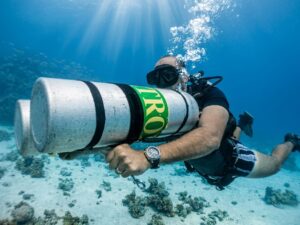
In a standard group setting, your dive time is limited by the fastest air consumer in the group. If an unconditioned diver depletes their cylinder in 35 minutes, your dive is over. With a private guide, your profile is limited only by your own respiratory efficiency and your computer’s decompression limits. Whether you prefer extended, shallow photographic profiles or technical, multi-cylinder recreational executions utilizing Enriched Air Nitrox, the dive plan bends to your capabilities.
The Value of an Analytical Briefing
A standard boat briefing involves a generic drawing on a whiteboard and a basic direction to “keep the reef on your left.” An elite private guide offers an analytical briefing rooted in physical oceanography. You will understand the subtle behavior of local currents, the thermal layers of the water column, the precise architectural layout of the coral pinnacle systems, and where specific pelagic or macro species are known to shelter based on the time of day.
Key Dive Sites of the Giftun Marine Park
To illustrate what makes this region so iconic, let us look at three definitive profiles that showcase the diversity of the Giftun ecosystem.
1. Shaab Sabina (The Coral Landscape)
Shaab Sabina is legendary for its unique underwater geography. The site features a narrow channel between the main reef and a massive coral ridge, creating a natural wind tunnel for nutrient-rich water.
As you execute a private drift dive through this channel, you pass over a vast, rolling landscape of hard corals that closely resembles an alpine forest covered in stone. Because the depth remains highly conservative ($10\text{ to }14\text{ meters}$), your gas consumption is minimal, allowing for unhurried exploration. It is a haven for green sea turtles, masked pufferfish, and massive schools of yellowtail barracuda that hang effortlessly suspended in the blue water.
2. Ben El Gebel (The Hidden Erg System)
Tucked between the two main Giftun islands, Ben El Gebel (often called “Torfa El Nast”) provides an exceptional playground for advanced buoyancy control. The site consists of a shallow reef tongue that drops into a sandy plateau at $16\text{ meters}$, out of which rise three spectacular, detached coral towers.
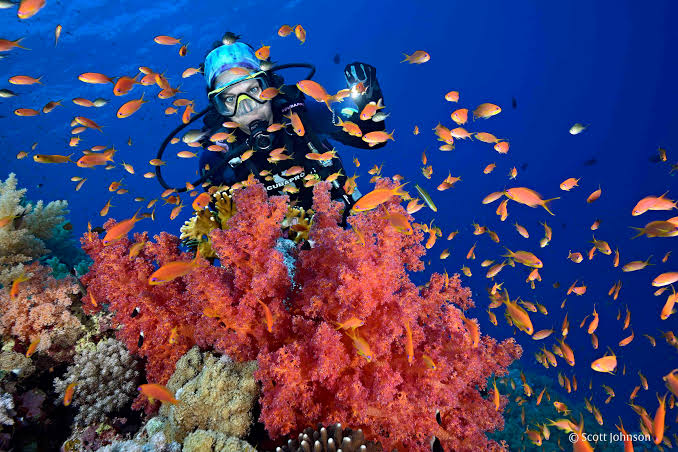
These towers are completely covered in soft neon broccoli corals and swathed in vast clouds of orange anthias fish. Because a private guide can navigate you between and around these towers away from the main boat paths, you have a high probability of encountering resident moray eels out hunting, camouflaged stonefish, and blue-spotted stingrays resting on the sandy floor.
3. Giftun Soraya (The Deep Wall Gateway)
For divers who hold advanced certifications and appreciate vertical scale, the eastern wall of Lesser Giftun provides an exhilarating contrast to the shallow gardens. Here, the reef shears straight down into the deep blue abyss.
This profile exposes you to the open ocean currents, introducing the potential for pelagic encounters. While your eyes scan the deep blue for passing whitetip reef sharks, eagle rays, or giant trevallies, the wall itself serves as a visual masterpiece, covered in massive gorgonian sea fans that stretch several meters across to catch passing plankton.